Saturday, March 16, 2013

North to Hoi An

Map picture
The overnight sleeper bus from Nha Trang—singularly comfortable—gets us in to the town of Hoi An by 6:30am.  We’re met by a scant English speaker from the hotel we’ve booked, and minutes later we’re in the small lobby of the Hoang Trinh Hotel, feasting on fruit, juice, tea and delectable coconut macaroons.  The room isn’t ready, so with map in hand from the incredibly kind and helpful staff, we wander into the old town.  In its 16th c. heyday, Hoi An was a town of thriving Japanese and Chinese merchants.  The north bank of the Thu Bon River remains the showcase of Hoi An’s mercantile past.  The ochre, ceramic-tiled roofs are a newer generation of the warehouses, homes of wealthy merchants and spectacular Chinese meeting houses from the early 1800’s, which have over time and due to the unforseeable silting up of the river, essentially ended Hoi An’s remarkable commerce.  Today the Old Town is a World Heritage UNESCO site, and fortunately, therefore, protected from the ravages of modern Vietnam.  It remains home to wonderful buildings, some of which are still completely wooden, most of them now shops, restaurants, small galleries, sprinkled with a liberal dose of Chinese meeting houses, Buddhist pagodas, catch-all museums and the ubiquitous markets.  Still standing, and partially renovated, is the lovely pinkish Japanese bridge— Hoi An’s most recognized landmark.

Wandering along both river banks is a pleasure, as they are pedestrian friendly.  During significant portions of the day the Old Town is only open to bicycles and pedestrians, which seems almost miraculous in this motorbike heaven.  Of our five days in Hoi An, three were spent wandering the streets and labyrinthine alleyways of the Old Town, stopping in at old traditional Meeting Houses, and visiting several of the many temples, and a couple of hodge-podge museums.  We made a regular stop to visit a lady called Mai at her stand in the central market for her delectable mixed fruit juice topped with some coconut chips, lychee, and dried cherries.  In the heat of the middle of the day we return to our cluttered room—adorned with such oddities as velvet heart pillows, teacups, a toilet paper roll holder(with toilet paper on it!), and read, rest and do the laundry, which we can conveniently hang on our minute balcony.  In the evenings the riverbanks are festooned with a rainbow of cloth lanterns, the bridges are lit, and the local vendors do their best to sell  their floating candle boats(meant to bring good luck), peanuts, ginger, and sweetened coconut.  There is a nightly sung game on a small square, which appears to be a sort of Bingo, which animated Vietnamese tourists attend in droves.  Night life per se is negligible, except from a backpacker bar on the south bank, and so it’s easy to fall into bed early, ready to begin the next day around dawn.

We (and all the other guests)were treated like family by the hotel, where one evening we were invited to a huge buffet/dinner given for all the guests(16 rooms worth), with all manner of local and regional Vietnamese dishes.  A veritable feast, one they appear do with some regularity.  We receive fruit juices and plates of fruit every afternoon as we dodge the worst heat of the day, and the staff graciously helps us book the next hotel, buy our bus tickets north, and anything else that might come up.  On the day we check out, we each receive a small gift from the staff, along with hugs and endless good wishes. 

Tuesday, March 12, 2013

Nha Trang

Map picture
Left the highlands of Da Lat for the urban beach town of Nha Trang.  Apparently the bus wasn’t full, so they put in a bus half the size, on which we literally bounced our way on the seriously winding road through the mountains  back into the lowlands.  The thermometer spiked accordingly.  Along the way we saw trickles of waterfalls(it’s the dry season now), stopped along a wide river where kids played in the shallow water, and rode through thick tropical vegetation, having left all the pines in the highlands.

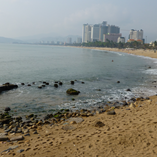
Once in Nha Trang, we came face to face with the first real flush of tourists.  The beachfront has been very nicely redesigned, and sports shady parks with sculptures, public bathrooms(almost unheard of in Vietnam), and a nice long walkway/sidewalk at the edge of the sand, but still a short distance from the main drag, which is incredibly full of motorcycles, busses and taxis, making it a nightmare to cross at virtually any time of day.  Settled into our hotel where the staff were extraordinarily friendly and helpful, as well as knowledgeable.  All the staff also spoke very solid English.  In the tourist/beach area, there are dozens upon dozen of eating establishments of all calibers, bars, tour offices, and the tourists are predominantly Russian.  Everything is written in the Cyrillic alphabet, and the solid Russian women take over local “beauty” shops, where they are in line for all manner of massages, depilatory treatments, wraps etc.  Late afternoons, once the sun has lost its real vigor, it’s off to the shops and massage places, immediately followed by bar hopping and eating the evenings away.  Not entirely our cup of tea, but having some non-Vietnamese food is a nice change, especially since it hasn’t proved to be very vegetarian at all, and much of the meat does honestly look questionable.

We stay off the beach proper, but spend a lot of time walking along it, and early in the morning head north up the beach and then inland to the ruins of Po Nagar Cham Towers, a site containing a series of Chinese Buddhist temple towers of the Cham people who inhabited this area about 1300 years ago.  A lot of the grounds were razed some time ago, but these four towers and a series of columns still stand on the little knoll.  It’s crawling with locals, who still come to pray here—despite the admission fee—, and they are shutter-happy, clicking zillions of family photos in every permutation at every temple doorway.  After looking around, we sit in the shade and watch the amusing commotion, and finally retrace the several kilometers back to the hotel. 

The following morning we’re again up early—mostly to beat the oppressive heat—and walk through the chaos of the non-tourist area, to the large Long Son Pagoda.  Not at all old, but certainly imposing, we find the main hall completely full of old men and women, all dressed in grayish jackets and pants, listening to a priest speak and chant.  We then head up the 150 stairs, past a small pavilion where people watch a priest strike the bell, and some are anxious to put their heads inside the bell while it is struck repeatedly—perhaps some sort of sound meditation/therapy, although it seems a little too brief to be either.  Further still lies the giant reclining Buddha, and at the very top of the hill, a colossal seated Buddha, who looks contemplatively down on the madness below.  On the way back to the hotel—taxi this time—, we stop in at the  photo gallery of local artist Long Thanh.  The artist has many of his stunning photos on display—most of the daily lives of the people in the country.  Check out his gorgeous work at : http://www.longthanhart.com/


We again change our plans, and decide to head out earlier than we’d planned, north to the world heritage city of Hoi An.

Friday, March 8, 2013

Rural Da Lat

Our guide Tuan and his driver are punctual as we set off to see some slivers of life in the countryside around Da Lat.  Even though we booked a small group tour, there are no other takers for today, and we’re lucky to set off alone.  Tuan’s English is really quite good, and he is excited to be able to practice with us all day.  He’s an interesting window into a country where lack of communication makes understanding the culture and what is going on around us challenging, but he is up for the task as we pepper him with questions all day long. 

Our stops are many.  We visit greenhouses full of flowers and vegetables—the heart of Da Lat’s economy.  We step into the coffee fields, a silk factory, a cricket farm(they’re raised for protein rich snack food), and we also take in pretty Elephant Waterfall, the adjacent pagoda, and wander some back roads to see how the ethnic minorities in the region live.  Our final stop is the “Crazy House”, back in the city, devised by a female architect who seems to have a touch of Gaudi, and who was much resented by the political class, but has been “let be” as her father was a bigwig in the communist secretariat.  She continues to add to the labyrinthine structure.

Perhaps the most outlandish experience of the day is visiting the “weasel coffee” house.  Here Tuan takes us in to see caged weasels, which he pronounces are—“very stinky”.  They are taken out to find/sniff out the ripest coffee, which they then eat.  (I think that they’re probably just fed coffee fruits here).  Their waste is then collected,  washed to clean off the still whole beans.  Dried and then lightly roasted, these beans purportedly make a less bitter and healthier drink(as the weasel’s digestion appears to add some sort of magical enzymes to the mix).  Fact or fiction?  Hard to know, but Andres went ahead and had a cup—although he’s not putting his stamp of approval on the drink any time soon!

We also really enjoyed the silk factory, a very small family affair, where you can see everything from the silkworms eating mulberry leaves, spinning cocoons, the unraveling of the cocoons into silk threads,  spinning these threads onto large spools, and finally the mechanical looms with the Player-Piano like cardboard patterns clacking away while weaving beautiful cloth. 

Perhaps most amusing of all was the fact that it was International Women’s Day, a holiday apparently taken very much to heart in Vietnam.  Tuan regaled us with stories about what his female friends expect from him—“even though just my friend, not girlfriend”.  Flowers, presents, and most striking, everywhere we went in the countryside, hordes of women were gathered together for festivities, singing and food.  “It’s like their day off.  Tomorrow back to cooking and cleaning and taking care of children,” Tuan explained to us.  He was adamant that this was only “fair”, considering that Vietnamese men are by his account still very chauvinistic, and waste hours on end smoking and drinking coffee with their equally indolent cronies.  And, sadly, that very much matched our observation of what appears to go on.  People wished me “Happy Woman’s Day” everywhere, and Tuan took Andres to task, inquiring what special things he had in store for me, deciding to get the whole day off to a good start by picking a rose in the flower gardens, smiling broadly the whole time.

As has been the case several times now, always a breath of fresh air to actually communicate with a local.  Check out pictures from the day below.  Tomorrow we move back to the coast and the town of Nha Trang.